
The best loss run software for MGAs reads reports attached to retail submissions, checks whether the history is complete and gives underwriters consistent claims data. LossRunReports fits desks that need requests and extraction at a published price. Pibit.AI and FurtherAI suit broader underwriting automation, while ordering tools handle the carrier request.
A wholesale desk rarely controls the original request. Retail agents send what they have, and the work begins with sorting those attachments. Compare tools on that incoming file before considering how well they order a replacement.
Try the reader on a loss run from your submission queue, no account needed.
What an MGA submission desk needs from loss run software
Retail agents send mixed carrier formats, scanned pages and spreadsheets, often with stale valuations. Triage starts by identifying the insured, policy periods and valuation dates. A report can cover the right policy term and still show reserves from an old evaluation. Set your market's acceptance window before testing currently valued loss runs.
A five-year summary needs the underlying history. Check how many years of loss runs a submission needs, including the current term and changes of carrier. Missing-year flags should prompt a document request, never turn a gap into a claim-free year.
Every underwriter needs the same claim fields and policy-year totals. An underwriting workbench for loss runs helps standardize that review. Keep earned premium aligned with the loss period when using loss run analysis to calculate loss ratio. Otherwise a tidy summary can still support a poor comparison.
Loss run software for MGAs compared
These products cover different jobs. Read the request and extraction columns separately, then consider whether your desk also needs scoring or rating. Published entry prices do not make their capabilities equivalent.
| Tool | Best for | Requests loss runs | Extracts claims | Price |
|---|---|---|---|---|
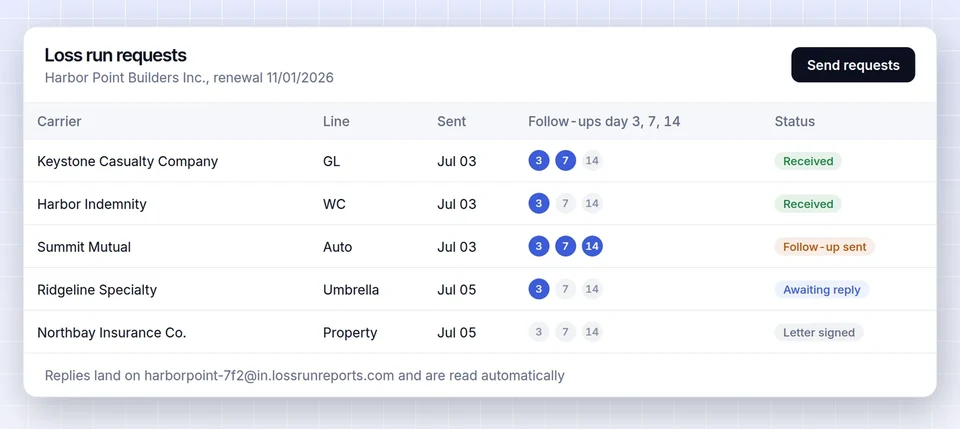
| LossRunReports | Agencies, MGA and wholesale desks | Yes, e-signed authorization, directory of 30 US carriers, follow-ups on day 3, 7 and 14 | Yes, PDF, scans, XLSX and CSV. Gap, duplicate and stale valuation checks, five-year summary. Agency adds loss ratio and editable underwriter narrative. Enterprise adds extraction endpoint API keys. | Broker $299/mo, Agency $1,499/mo, Enterprise $4,999/mo. Yearly billing is about half, at $149, $749 and $2,499/mo respectively.Agency · Recommended for MGA desks |
| Pibit.AI | Carriers, MGAs, MGA aggregators and mutuals | No request or chase | Yes, intake and extraction of loss runs, ACORD, SOV, MVR and mods, plus risk scoring and rating | Quote only, demo |
| FurtherAI | Carriers, MGAs, brokers and reinsurers | Works with ACORD 611 requests, no built-in chase described | Yes, PDF, Excel and CSV, deduplication, loss triangles and missing-year flags | Demo, no public price |
| Sensible | Developer teams building their own pipeline | No | Yes, API extraction to JSON | Growth $499/mo for 750 documents, Scale $1,499/mo for 3,200 documents |
| Loss Run Pro | Agencies ordering prior-carrier reports | Yes, e-sign requests and delivery | No claim extraction on Standard | Standard $29 per user a month |
| Appulate LossRunner | Agencies on Appulate | Yes, BOR/LOA and request letters with e-sign | No | Free for agents |
| Outmarket AI | Retail brokerages wanting a broad AI workspace. Compare an Outmarket AI alternative. | Orders through its Loss Run Pro integration | Yes, claim by claim with total checks and multi-tab Excel | Lite $83 per seat a month billed annually, 1 to 4 seats. Enterprise quoted. |
Vendor details from each vendor's public site, checked October 2026.
Best loss run software for a small MGA or program administrator
LossRunReports is a practical choice for a small MGA or program administrator that needs attached reports read without building an intake platform. Broker starts at $299 a month for requests, extraction and a five-year summary. Agency adds loss ratio and an editable underwriter narrative when the desk needs submission preparation.
Choose by work remaining after the report arrives. Loss Run Pro Standard and Appulate LossRunner cover ordering, so someone still reads claims and reconciles totals. Our Loss Run Pro alternative comparison explains that distinction. Use the insurance agency software comparison if your operation also handles retail renewals.
Best loss run software for a wholesale broker submission desk
LossRunReports Agency fits a wholesale submission desk that receives loss runs from retail agents and needs consistent summaries across markets. Its 3,000-document monthly allowance, loss ratio and editable narrative support that workflow. The request function matters when an attachment is stale or incomplete, even if the retail agent supplies most reports.
Keep the handoff explicit. Flag the missing term, ask the retail agent for a replacement and confirm who has authority to request it. For program business, the desk also tracks obligations beyond claims history. MGAs use contract management software to track binding authority and program agreements with each carrier and their renewal dates, a separate job from loss run review. Keep those agreement records alongside the program's submission requirements.
Best loss run software for a carrier-backed MGA with underwriting automation
Pibit.AI and FurtherAI belong on the shortlist for a carrier-backed MGA buying broader underwriting automation. Pibit.AI combines document intake with risk scoring and rating, while FurtherAI offers extraction, loss triangles and missing-year flags. Both require a demo and quote, so evaluate the wider workflow rather than loss runs alone.
Bring ACORD applications, exposure schedules and loss runs to that demo. Ask which extracted fields feed rating and which decisions remain with the underwriter. Our Pibit.AI alternative and FurtherAI alternatives for insurance brokers guides help distinguish a document workflow from a broader platform purchase.
Best loss run software for developers building an intake pipeline
Sensible suits developers who want loss run data returned as JSON inside their own pipeline. LossRunReports Enterprise is another option when extraction endpoint API keys sit alongside requests and underwriting summaries. Compare the response fields and document allowances first, then assign responsibility for reconciliation, exception handling and the underwriter's review screen.
An extraction API does not by itself create a submission desk. Your team still defines policy-year mapping, manages repeat uploads and preserves the link to the source report. LossRunReports uses OCR and extraction rules to read documents. Test the resulting claims against carrier totals before sending data into a rating system.
How to choose loss run software for an MGA
Use a real submission with mixed formats and an open claim. Follow the file from upload through export, checking the carrier totals and the exceptions your underwriters need to resolve.
- Read attached reports. Test files supplied by a retail agent, without sending a new carrier request first. Confirm scans and spreadsheets work alongside native PDFs.
- Flag valuation dates. Distinguish the valuation date from policy expiration and date of loss. Make sure stale or missing dates remain visible during review.
- Check the output schema. Map paid, reserved, incurred, recoveries, claim status and policy periods to your rating system. Inspect an export rather than relying on a screenshot.
- Calculate cost at your volume. For example, 2,000 documents a month fits Agency's 3,000 cap. At $1,499 monthly, that is about $0.75 per document at that usage. Check account limits too.
- Review retention and deletion. Match document storage to carrier agreements. Enterprise offers custom retention from 30 days to 7 years and automatic deletion when retention ends.
- Start with a published price. Compare document allowances, seats and billing terms. For quoted platforms, request those same details. Our loss run software pricing guide separates ordering costs from extraction costs.
Frequently asked questions
What is the best loss run software for MGAs?
LossRunReports fits MGAs that need to request, read and summarize loss runs at a published price. Agency adds loss ratio and an editable underwriter narrative. Pibit.AI and FurtherAI are stronger candidates when the purchase covers broader underwriting automation, with Pibit.AI also offering risk scoring and rating.
Do MGAs need loss run software if retail agents send loss runs?
Yes, if reading and checking those attachments consumes desk time. Retail delivery solves receipt, but it does not standardize claims, identify missing policy years or confirm valuation dates. An MGA can use extraction and review without ordering every report, then request replacements when the submitted history is incomplete.
How much does loss run software cost for an MGA?
LossRunReports costs $299 a month for Broker, $1,499 for Agency and $4,999 for Enterprise. Yearly billing brings the monthly equivalents to $149, $749 and $2,499. Pibit.AI and FurtherAI quote after a demo. Compare the included document volume and underwriting features before choosing a plan for your desk.
Can loss run software flag loss runs that are not currently valued?
Yes. LossRunReports includes stale valuation checks, which help a desk identify reports needing a refresh. Check the extracted valuation date against the source document and apply the receiving market's requirements. A flag supports review, but it does not replace obtaining a current report or resolving a missing date.
Does LossRunReports work for wholesale brokers?
Yes. Wholesale brokers can upload loss runs received from retail agents, extract claims and build a five-year summary. Agency adds loss ratio and an editable narrative. When a report needs replacing, the request workflow uses e-signed authorization and carrier follow-ups, subject to having the insured's authority to request it.
Review loss run software for MGAs and wholesalers for the desk workflow, then compare document limits and billing options on the pricing page.