
Currently valued loss runs are loss runs whose valuation date is recent, usually within 60 to 90 days of the submission date, so open reserves, new claims and closed files reflect the account as it stands today. Most commercial underwriters reject or discount older reports because claim values change after the report is run.
"Please provide currently valued loss runs" is one of the most common replies a broker gets from a market, and it usually arrives after the submission has already gone out. Understanding what the valuation date means, why markets care about it, and how to plan around it keeps renewals on schedule.
What the valuation date is
Every loss run is a snapshot. The valuation date (also printed as "valued as of", "evaluation date" or "run date") is the day the carrier pulled the numbers from its claim system. Paid amounts, reserves, claim status and claim count are all correct as of that day and no later.
Claims keep moving after the snapshot. An adjuster raises a reserve after a medical report. A claim that looked closed reopens. An accident that happened last week gets reported. None of that appears on a report run three months ago. The valuation date tells the underwriter how much of that movement they are not seeing.
Valuation date versus policy term
The two are often confused. The policy term is the coverage period, for example March 1, 2025 to March 1, 2026. The valuation date is when the report was run, for example January 15, 2026. A loss run for a term that ended two years ago can still be currently valued, as long as the carrier ran it recently. Old terms matter because claims from those terms can still be open.
Why underwriters reject old loss runs
- Reserves change. The single biggest reason. A bodily injury claim reserved at $15,000 at one valuation can be reserved at $75,000 three months later once the injury is better understood.
- New claims appear. The current term is still running. A 120-day-old report can miss a third of the year's claims.
- Status changes. Open claims close, closed claims reopen, and litigation starts.
- Pricing depends on it. Loss ratio and frequency are only as reliable as the losses behind them. An underwriter pricing from stale numbers is pricing the account they saw months ago.
- Carrier guidelines. Many carriers write a maximum report age into their underwriting guidelines, so the underwriter may not be allowed to quote on an older report even if they want to.
How recent is recent enough
There is no single industry rule, but practice clusters around a few thresholds.
| Report age at submission | How markets usually treat it |
|---|---|
| Under 30 days | Accepted everywhere |
| 30 to 60 days | Accepted by nearly all markets |
| 60 to 90 days | Accepted by most; some ask for an update on open claims |
| 90 to 120 days | Often returned with a request for current loss runs |
| Over 120 days | Treated as stale; expect a re-request before a quote |
Treat 90 days as the outer limit and 60 days as the target. Some specialty and excess markets are stricter, and a few will accept older reports for long-closed terms if a current report covers the open claims. When in doubt, ask the underwriter before you submit, not after.
Planning the renewal timeline around valuation
The tension is simple. You need loss runs early enough to market the account, but late enough that they are still current when the underwriter reads them. A timeline that handles both looks like this, using a fictional insured, Copperfield Bakeries LLC, renewing on July 1.
| Days before renewal | Date | Step |
|---|---|---|
| 120 | March 3 | Request loss runs from all carriers for five years plus current term |
| 106 | March 17 | All reports received after follow-ups on day 3, 7 and 14 |
| 90 | April 2 | Summary built, submission goes to markets with reports about 2 to 4 weeks old |
| 60 | May 2 | Quotes arriving; reports now 6 to 8 weeks old, still within range |
| 45 | May 17 | Request a refreshed valuation from the incumbent if open claims are material |
| 0 | July 1 | Bind |
The second request at 45 days is optional but useful when the account has large open claims. Markets often make binding subject to no material change in loss experience, and a fresh report from the incumbent settles the question quickly.
Which reports to refresh first
You rarely need to re-request every report. Prioritize like this.
- The current term. Always the most likely to change.
- Any term with open claims. Reserves on open claims are what moves.
- Any term with recent litigation or large losses.
- Closed terms with no open claims. These change rarely, and some markets accept them at an older valuation.
How to request a current valuation
Reply on the original request thread to the same carrier unit, refer to the earlier report and its valuation date, and ask for a report run as of today for the listed policies. The letter of authority you already have normally covers the re-request if it is still within its validity period. If you need a fresh letter or the full request process, see how to request loss runs from any carrier and the loss run request letter template.
Spotting stale loss runs in a file
When a renewal file has a dozen reports from four carriers, the stale one is easy to miss. Check each report for:
- A printed valuation or run date. If there is none, the report cannot be called currently valued, and the underwriter will ask.
- Age in days at the planned submission date, not today.
- A current term that ends before the actual current term, which means the report was run before the last renewal.
- Open claims with no movement in paid amounts between two reports, which can mean the newer report is a copy of the older one.
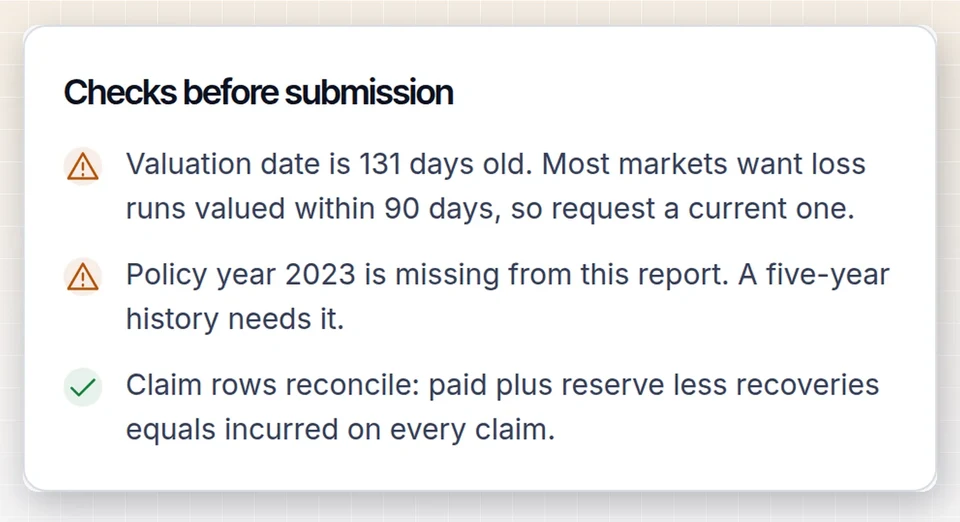
Our loss run software reads the valuation date from every report as it arrives and flags any valuation older than 90 days, so the submission desk sees what needs a refresh before a market does. You can also read more on how the review fits into loss run analysis.
Currently valued and the summary
When reports in one summary carry different valuation dates, print each report's valuation date next to its policy year. Underwriters expect mixed dates across carriers, but they need to see them. A summary that hides valuation dates looks like it is hiding something. If you build the summary in a spreadsheet, the insurance loss run template for Excel has a valuation column and an age check built in.
When a market sends the loss runs back
If an underwriter returns the submission for current loss runs, do three things the same day. Confirm which reports they consider stale, since it is often only one carrier or one term. Send the refresh request to that carrier at once and tell the underwriter when you expect it. Then, if the account has a meaningful open claim, add a short note from the insured or the adjuster on its status. A clear explanation of an open claim often keeps the underwriter working on the quote while the new report is on its way.
Loss run timing is also a client conversation. Insureds who understand why the request goes out four months before renewal are far quicker to sign the letter of authority and to push a slow carrier themselves.
Key points
- The valuation date is when the carrier ran the report, not the policy term.
- Target reports under 60 days old at submission and never more than 90.
- Request at 120 days, submit at 90, refresh open terms around 45 days if needed.
- Refresh the current term and terms with open claims first.
- Show valuation dates in the summary, per carrier and per term.