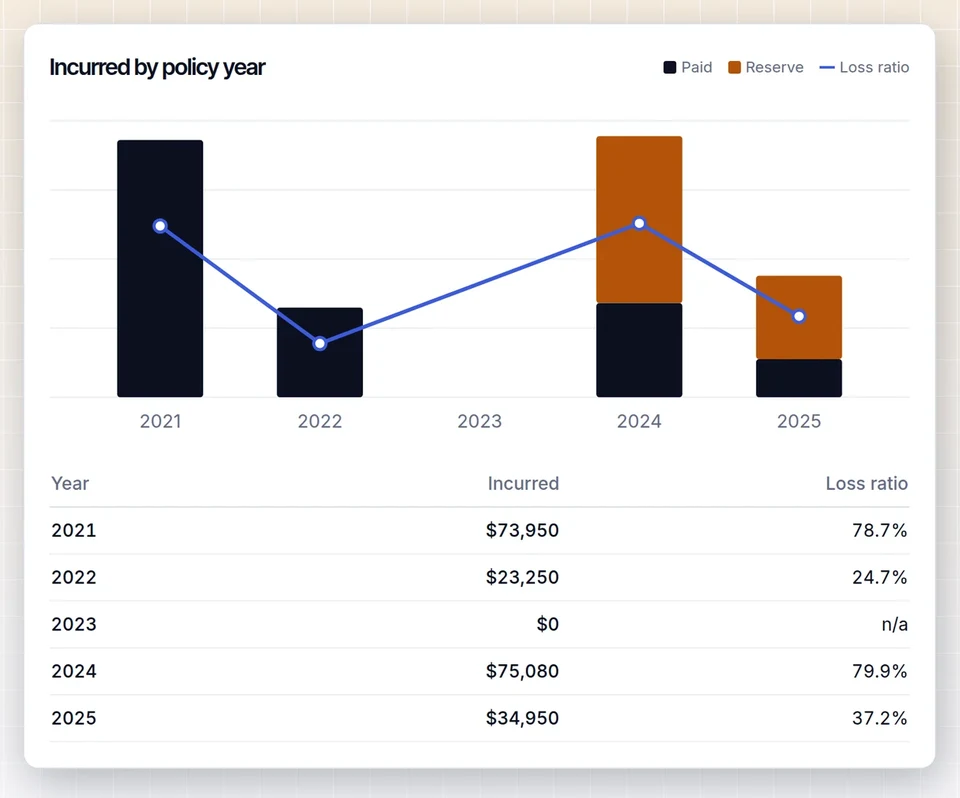

Most commercial insurance submissions need a 5 year loss run, meaning five full policy years of claim history plus the current partial term, all currently valued. Small accounts sometimes get by with three years, while long tail lines, large accounts and some excess or specialty markets ask for seven to ten years.
Asking for the right number of years up front saves a second round of requests, which is exactly the kind of delay that pushes a renewal into the last month. This guide covers the standard, the exceptions by line and account size, and what to do when part of the history is missing.
Why five years is the standard
Five years is long enough to separate a pattern from bad luck. One large claim in a single year can make an account look terrible. Over five years, the underwriter can see whether that claim was an outlier and whether claim frequency is rising, falling or flat. It also covers at least one full renewal cycle with most carriers, so the history usually spans more than one insurer.
Five years is also short enough to be practical. Carriers keep claim data far longer, but older reports are harder to get, especially from carriers the insured left years ago, and operations from a decade back may say little about the business today.
What "five years plus current" means
If the renewal date is June 1, 2026, a five year loss run covers these terms.
| Term | Policy period | Status at submission |
|---|---|---|
| Current | June 1, 2025 to June 1, 2026 | In force, partial year |
| Year 1 | June 1, 2024 to June 1, 2025 | Expired |
| Year 2 | June 1, 2023 to June 1, 2024 | Expired |
| Year 3 | June 1, 2022 to June 1, 2023 | Expired |
| Year 4 | June 1, 2021 to June 1, 2022 | Expired |
| Year 5 | June 1, 2020 to June 1, 2021 | Expired |
That is six terms in total. A common mistake is to request "the last five years" and receive five terms that include the current one, leaving the oldest full year missing. Spell out the policy periods in the request. Our guide on how to request loss runs from any carrier includes a request table that does this.
Years of history by line and situation
These ranges reflect common market practice. Individual carriers set their own guidelines, so always check the underwriter's submission requirements.
| Line or situation | Typical requirement | Why |
|---|---|---|
| Small commercial package or BOP | 3 years, sometimes 5 | Low premium, simplified underwriting |
| General liability | 5 years plus current | Standard practice |
| Commercial auto | 5 years plus current, often with an MVR driver list | Frequency and driver trends |
| Workers compensation | 5 years plus current | Also feeds the experience mod, which uses three completed years |
| Property | 5 years plus current | Catastrophe and water losses can be infrequent but large |
| Umbrella and excess | 5 years for all underlying lines, sometimes longer | Excess layers care about large losses |
| Products liability, professional, construction defect | Often 7 to 10 years | Long tail, claims are reported years after the work |
| Large accounts and loss-sensitive programs | Often 7 to 10 years with development data | Actuarial pricing needs more data |
Workers comp is a special case
For workers compensation the market wants five years of loss runs, but the experience modification factor uses a different window. Under NCCI rules the experience period is generally the three most recent completed policy years ending one year before the rating effective date, so the most recent year is excluded. Reading five years of loss runs lets you see both what goes into the mod and what is coming next. More detail is in workers comp loss runs and the experience mod and on our workers comp loss runs page.
When the business is less than five years old
Newer businesses cannot produce five years, and underwriters know that. Provide loss runs for every term that exists, and add context.
- A short note with the date operations started.
- Prior experience of the owners in the same industry, if relevant.
- If the business bought or succeeded another company, loss runs from the predecessor where available.
- A signed no-known-losses statement for any period with no coverage history, if the market requests one.
When a carrier cannot produce older years
Insolvent carriers, carriers that have been merged, and books moved through several MGAs can make old years hard to get. Try these routes in order.
- The prior agent of record, who may have the reports on file.
- The insured's own records, since many receive loss runs at each renewal.
- The acquiring carrier or the state guaranty fund for insolvent carriers.
- For workers comp, the rating bureau's experience rating worksheet, which lists claims from the experience period.
If none of these work, tell the underwriter which year is missing and why, and provide everything else. A clearly explained gap is far better received than an unexplained one.
When more history helps the insured
Longer history is not only something markets demand. It can also work in the insured's favor. Consider a fictional manufacturer, Lakeshore Fixtures Inc., with one $180,000 products claim in the most recent full year and almost nothing else. On a three year view, that claim dominates the loss ratio. On a seven year view, it sits beside six years of minimal losses and looks like what it is, a single severe event. When an account has one bad year, offering more years than the market asked for is often the strongest argument a broker has.
The opposite also applies. An account whose losses are concentrated in the last two years will not look better with more history, and an underwriter will focus on the trend anyway. In that case, put the effort into explaining what changed and what the insured has done about it, such as new safety programs, driver training or a discontinued product line.
How to phrase the request to the carrier
Carriers answer the question you ask. "Loss runs for the last five years" can return five terms, four terms or everything since inception depending on who processes it. Write the request as a list of policy numbers with effective and expiration dates, and ask for currently valued reports for each, including a no-loss confirmation for any term without claims. Our loss run request letter template is laid out this way.
Five years of reports, one summary
Five years plus current across three carriers can mean fifteen separate reports in three formats. Underwriters do not want fifteen PDFs. They want a single summary by policy year with claim counts, paid, reserved, incurred, earned premium and loss ratio, plus the source reports behind it. The Excel loss run template shows that layout, and the loss ratio guide walks through the math with a worked example.
Building that summary by hand is where most of the hours go. Our loss run software requests each term from each carrier, reads PDF, scanned, XLSX and CSV reports into one claims schema, flags missing terms and stale valuations, and builds the five-year summary with loss ratio automatically. The summary drops straight into the submission package, described in our commercial insurance submission automation page.
A quick check before you submit
- Count the terms. Five full years plus the current term, or every term since inception.
- Match each term to a report or a no-loss letter. No silent gaps.
- Check valuation dates. Within 90 days at submission, ideally 60.
- Confirm the line requirement. Long tail lines may need more.
- Build one summary and attach the source reports.
Getting the number of years right at the first request is the easiest way to keep a renewal on schedule. Ask for five plus current by default, more for long tail lines and large accounts, and check the market's guidelines when you are unsure.