Guide
How to request loss runs
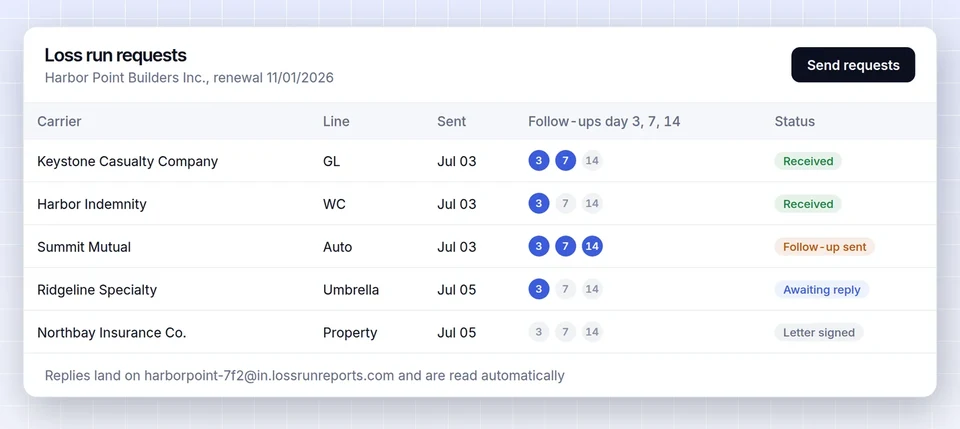
To request loss runs, send each prior carrier a written request with the insured name, FEIN, policy numbers and terms, the years you need and a letter of authority signed by the insured if you are not the agent of record. Ask for currently valued reports, then follow up on day 3, 7 and 14.
Swipe to see every column

The six steps carriers expect
Loss run departments process thousands of requests. A complete request gets answered first. An incomplete one waits for a clarification email that nobody sends.
-
Step 1
Confirm who is asking
Carriers release loss runs to the named insured or to an agent the insured authorizes. If you are not the agent of record, get a signed letter of authority from the insured before you ask.
-
Step 2
List every prior carrier and policy
For each line, list the carrier, policy number and policy term for the last five years. Missing one term is a frequent reason a submission comes back incomplete.
-
Step 3
Prepare the request letter
Include insured name, mailing address, FEIN, policy numbers and terms, the lines of business, the years requested, the valuation you need (currently valued) and where to send the reply.
-
Step 4
Send it to the loss run department
Use the carrier loss run or policy services email, the agent portal, or fax when that is the only channel. Keep a reference number in the subject line.
-
Step 5
Follow up on a schedule
Follow up on day 3, day 7 and day 14. Most delays come from requests that were never acknowledged or sent to a general inbox.
-
Step 6
Check what arrives
Confirm the valuation date is within 90 days, every policy year is present, totals add up, and open claims show reserves. Request again if anything is missing.
If you are not sure what a carrier report should contain, start with what a loss run report is and how to read each column.
A sample loss run request
Short, specific and complete. Replace the bracketed fields and attach the signed letter of authority.
Subject: Loss run request, [Insured name], ref [LR-XXXXXX]

To the Loss Run Department, [Carrier name]

On behalf of our client, please send currently valued loss runs
for the policies below.

Named insured: [Legal name of insured]
Mailing address: [Street, city, state, ZIP]
FEIN: [XX-XXXXXXX]

Policies requested:
  [Line]  [Policy number]  [Term start] to [Term end]
  [Line]  [Policy number]  [Term start] to [Term end]

Years requested: the last five policy years, including the
current term, valued within the last 30 days.

Please include claim-level detail: claim number, date of loss,
claimant, cause, status, paid indemnity, medical and expense,
reserves, recoveries and total incurred. If there were no claims,
please send a no-loss letter for each term.

A letter of authority signed by the insured is attached.

Please reply to [agency inbound address] and keep the reference
number in the subject line.

Thank you,
[Your name], [Title]
[Agency name]
[Email]
Why each line is there
The reference number lets the reply land on the right account. The FEIN and policy numbers let the carrier find the insured without a phone call. Asking for claim-level detail avoids a summary page that shows only totals, which most underwriters will not accept.
The no-loss letter request matters more than it looks. A year with no claims and no letter reads as a missing year, and missing years are where markets assume the worst.
A full version with an ACORD-style layout and a letter of authority template is on the loss run request letter page.
Follow-ups without the spreadsheet
The request is the easy part. Keeping track of twenty carriers across forty renewals is where the hours go.
Oct 1, 9:12
Request sent to [email protected]
Oct 4, 8:00
Follow-up 1 sent automatically (day 3)
Oct 8, 8:00
Follow-up 2 sent automatically (day 7)
Oct 15, 8:00
Follow-up 3 scheduled (day 14)
Oct 21
Marked overdue, account manager notified
A workable rhythm is a polite follow-up on day 3, a firmer one on day 7 with the original request quoted, and a final one on day 14 copying the underwriter or the carrier service center. After that, the request is overdue and the producer should know.
LossRunReports runs that rhythm for every request automatically. Each carrier request carries its own status, so an account manager can see in one list which reports are received, which were acknowledged, and which carriers have gone quiet.
Replies go to a dedicated inbound address for your agency. Attachments are matched to the request by reference number, policy number or upload link, then read straight into the claims table. Our loss run software page shows the full flow.
When to start the request
120 days before expiry
For renewals that will be marketed. It leaves time for slow carriers and for a second request if the first report is incomplete.
Same day for new business
As soon as the prospect signs the letter of authority. Prospects compare agents on speed.
Again at 30 days before binding
If the first reports are older than 90 days by the time the market quotes, ask for an updated valuation.
Common questions about requesting loss runs
Can an agent request loss runs without the insured signing anything?
The agent of record can usually request loss runs for its own policies. Any other agent needs written authorization from the insured, typically a signed letter of authority naming the agency.
How long do carriers take to send loss runs?
Many carriers respond within a few business days, and some state laws set a deadline for providing loss information on request. In practice, unacknowledged requests are the main cause of delay, which is why a follow-up schedule matters.
How many years of loss runs should I request?
Five years is the usual standard for commercial lines, including the current term. Some markets accept three years for small accounts, and some excess and umbrella markets ask for more.
What does currently valued mean?
It means the report was produced recently, generally within the last 90 days, so paid amounts and reserves reflect the current state of each claim.
Can the insured request loss runs directly?
Yes. The named insured can always request its own loss runs. Many agencies still handle it so the request is complete and the reports arrive in one place.
See your own loss run read in under a minute
Upload one carrier report or use our sample. No account needed for the first read.