
The best FurtherAI alternatives for an insurance broker depend on which half of the loss run job you are buying for. If you want claims pulled out of carrier reports, Pibit.AI, Sensible and Intellect's Magic Loss Runs are the closest extraction tools. If you also need the requests sent and the slow carriers chased, LossRunReports covers the whole loop, from the signed letter of authority to a five-year loss summary, at a published price.
FurtherAI is a well-funded AI workspace for insurance, and its loss run module is strong. It is also sold through a demo, priced on request and pitched first at carriers, MGAs and reinsurers. A retail agency with a commercial book often wants something it can trial on Monday and put on a credit card. That is the gap this comparison is about.
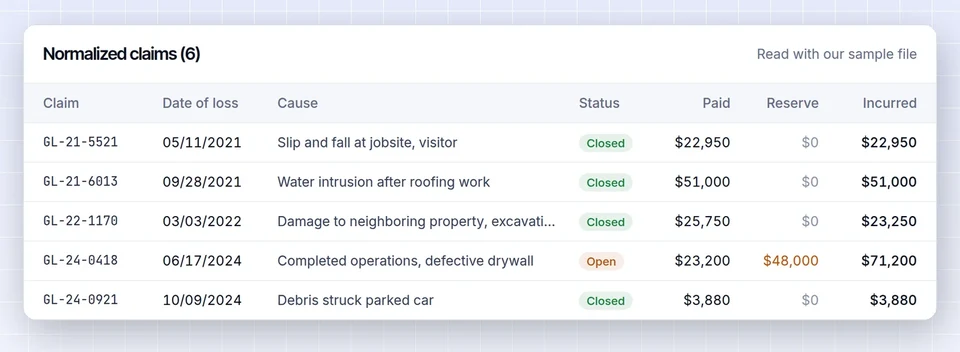
Run your own loss run through a reader before any demo call. Ours works right here:
FurtherAI alternatives compared
The table sorts the realistic options by what they actually do with a loss run. Details come from each vendor's public website or marketplace listing as of October 2026. Accuracy claims are the vendors' own, not independent tests.
| Tool | What it does with loss runs | Best for | How you buy it |
|---|---|---|---|
| LossRunReports | Requests, follows up on day 3, 7 and 14, extracts claims, reconciles totals, builds a five-year summary | Commercial agencies, MGA and wholesale desks | Published plans from $299 a month, $149 billed yearly |
| FurtherAI | Ingests PDF, Excel and CSV, deduplicates across carriers and years, builds loss triangles and trends | Carriers, MGAs, large brokers | Demo, price on request, no free trial listed on Capterra |
| Pibit.AI | AI loss run extraction as part of underwriting intake | Underwriters and smaller agencies | G2 lists $29.99 a seat a month with a 14-day trial |
| Sensible | Developer API that turns loss runs into schema-checked JSON, with each value linked to its place on the page | Teams with engineers building their own workflow | Self-serve API plans and sales |
| Intellect Magic Loss Runs | Containerized extraction for commercial, specialty and E&S loss runs, JSON or CSV out | Carriers and MGAs with IT on AWS | AWS Marketplace listing |
| Outmarket AI | Loss run extraction and analysis inside a broker marketing platform | Retail brokers who want a full placement platform | Demo |
| Loss Run Pro | Orders loss runs with e-signed letters and tracks them; no claims extraction on the Standard plan | Agencies that only need ordering | $29 a user a month on Standard |
Why do brokers look for a FurtherAI alternative?
Brokers usually look for a FurtherAI alternative for one of three reasons: they cannot get a price without a sales cycle, the product is broader than the one job they need done, or it starts after the loss runs have already arrived. None of these is a flaw in the extraction. They are fit problems for a retail agency.
FurtherAI describes itself as a workspace that automates submission processing, eligibility checks, claims intake, underwriting audits and more. Its customer page lists carriers, MGAs, brokers and reinsurers, and lines from commercial property and fleet to cyber and life. That breadth is the point for an MGA rebuilding its underwriting desk. For a 12-person agency that just wants to stop retyping claims at renewal, it is a lot of platform.
The other gap is the front of the process. FurtherAI says its loss run module works with the ACORD 611 requests or carrier portals you already use. In other words, someone at the agency still sends the request and chases the carrier that goes quiet. If your slowest week is the one spent waiting on a carrier, extraction alone does not shorten it.
What is the best FurtherAI alternative for a retail agency?
For a retail commercial agency, the best FurtherAI alternative is a tool that both gets the loss runs and reads them, at a price you can see before a call. LossRunReports fits that description: the insured signs once, requests go to every prior carrier, follow-ups run on day 3, 7 and 14, and each report becomes rows in one claims table with a five-year summary on top.
Here is what that looks like in practice. A CSR opens a contractor account 120 days before expiration. The account already has three prior carriers. The letter of authority goes to the insured for an online signature, three requests go out from the agency's own address, and the tracker shows each one as sent, acknowledged, received, incomplete or overdue. When the scanned PDF from one carrier and the XLSX export from another arrive, both are read into the same columns: claim number, date of loss, cause, status, paid, reserves, recoveries and incurred.
Before anyone sees the result, the extracted claims are added up and compared with the totals the carrier printed. A missing policy year, a duplicate claim or a valuation older than 90 days gets flagged so the CSR can go back to the carrier now rather than after the underwriter asks. The full output is shown on our loss run analysis page.
Where we are weaker than FurtherAI: we do not sell a general underwriting workspace, we do not do life and health lines, and we do not build reinsurance-grade triangles for carrier actuaries. If that is your job, FurtherAI or a carrier-focused tool is the better pick.
Pibit.AI, Sensible and Intellect for extraction only
If your agency is happy with how it orders loss runs and only wants the reading automated, three extraction tools are worth a look.
Pibit.AI is the easiest to trial. G2 lists a plan at $29.99 a seat a month with a 14-day trial, and its loss run reader sits inside a broader underwriting intake product. It suits a small team that wants extraction cheaply and can live without request tracking.
Sensible is a developer tool. It converts loss runs into JSON that matches a schema you define and links every extracted value back to its page and position for audit. If you have an engineer who wants to wire loss run data into your own rater or data warehouse, it is a clean building block. If you do not, it is a project rather than a product. Agencies that need the same kind of extraction across invoices, contracts and statements, not only loss runs, may be better served by a general enterprise document data extraction platform.
Intellect Magic Loss Runs is sold as a container on AWS Marketplace and handles commercial, specialty and E&S loss runs, including scans, with JSON or CSV output. It is built for carriers and MGAs that run their own infrastructure. A retail agency without IT staff will find the deployment heavier than the problem.
How much does FurtherAI cost compared to the alternatives?
FurtherAI does not publish a price. Its site offers a demo and an ROI report, and Capterra lists no free trial, so expect a custom quote sized to your volume and the modules you buy. The alternatives range from about $30 a seat for extraction-only tools to flat monthly plans for tools that cover the full loss run workflow.
Our own plans are public. Broker is $299 a month, or $149 billed yearly, for 50 client accounts and 300 loss run documents a month. Agency is $1,499 a month, or $749 billed yearly, for 400 accounts and 3,000 documents, and adds loss ratio from earned premium, a renewal pipeline that starts requests 120 days before expiration and a one-click submission builder. Enterprise is $4,999 a month. There are no per-document fees on any plan, and the details are on our pricing page.
When you compare, price the hours as well as the license. FurtherAI's own ROI example assumes 1.5 hours of staff time per loss run at $40 an hour. Whatever tool you choose, that is the number it has to beat on your book.
How to choose between FurtherAI and an alternative
Choose by running the same ugly loss run through every tool on your shortlist. Pick a scanned report with open reserves, a mid-term carrier change and a missing year. Then check the extracted claims against the carrier's printed totals and note who caught the gap. Four more questions settle most decisions:
- Who sends the request and chases the carrier? If the answer is "still us", count those hours in the cost.
- Can you see a price before a call? A published plan means you can test it on this month's renewals.
- Is it built for brokers or for underwriters? A carrier-side tool may assume one loss run per submission, while a broker deals with five carriers per account.
- What comes out the other end? A five-year summary you can send to market, or raw JSON your team still has to shape?
If ordering is the only gap, our comparisons of the Loss Run Pro alternative and the Appulate LossRunner alternative cover the request side in detail. For a wider view of the market, see our roundup of the best loss run software for insurance agencies.
Frequently asked questions
Is FurtherAI only for carriers?
No. FurtherAI lists carriers, MGAs, brokers and reinsurers as customers, and its loss run page talks to brokers and underwriters. In practice its platform breadth, demo-led sales and integrations such as SharePoint and the Microsoft Marketplace suit larger organizations more than small retail agencies.
Does FurtherAI request loss runs from carriers?
FurtherAI says its loss run module works with the ACORD 611 requests or carrier portals you already use, and it flags missing years or carriers so you can ask for them. The request and the follow-up still come from your team. LossRunReports sends the request and follows up automatically.
Can AI extract claims from scanned loss runs?
Yes. Current loss run readers, including FurtherAI and Intellect, read scanned PDFs as well as native PDFs and spreadsheets. LossRunReports reads scans with OCR and extraction rules. The thing to test is reconciliation: a good tool compares extracted claims with the carrier's printed totals and flags any difference for a person to check.
Is there a FurtherAI alternative with a free trial?
Pibit.AI lists a 14-day trial on G2. LossRunReports lets you upload a carrier loss run into the reader on this page and see the extracted claims and totals without creating an account, then choose a paid plan when you are ready to run renewals through it.
Not sure where your team loses the most time? Start with the loss run software overview, or drop one report into the reader above and compare the output with what you would have typed by hand.