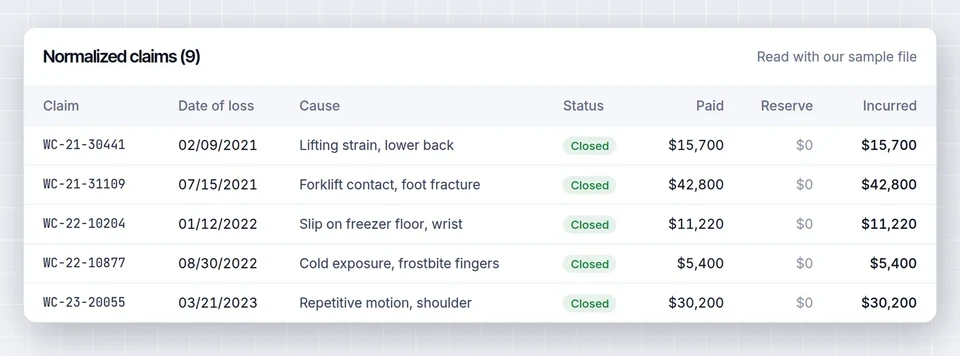

A loss run report is the insurance carrier's record of every claim filed under a policy, showing each claim's date of loss, description, status and the amounts paid, reserved and incurred as of a valuation date. Underwriters use it to judge how often an insured has losses, how large they are and whether the trend is improving.
Every commercial insurance submission needs loss runs, and every carrier prints them differently. One carrier sends a tidy spreadsheet, another a 14-page scanned PDF with claims grouped by coverage part. The information underneath is the same, and once you know what each field means you can read any loss run in a few minutes. This guide walks through the layout, the columns, and the questions an underwriter asks of every report.
Why loss runs matter
Past losses are the best predictor most underwriters have of future losses. A carrier pricing a general liability policy for a contractor wants to know whether that contractor had one slip and fall in five years or one every quarter. The loss run answers that question with the carrier's own numbers, which is why markets rarely quote a commercial account without it.
Loss runs also matter to the insured. A business that switches carriers, adds a location, applies for a contract that requires proof of a clean record, or disputes a reserve all need the report. Owners are often surprised to learn that open claims with large reserves count against them at renewal even when nothing has been paid yet.
The parts of a loss run report
Nearly every loss run has three parts, whatever the carrier's format.
- Header. Named insured, policy number, policy term, line of coverage, and the valuation date (sometimes labeled "as of" or "evaluated"). Some carriers include the agency and the date the report was run.
- Claim detail. One row or block per claim, with the fields described below.
- Totals. Sums of paid, reserved and incurred amounts per policy term and often per coverage, plus a claim count.
If a policy term had no claims, the carrier should state that the term had no reported losses. A blank page is not the same thing, and underwriters will ask for confirmation.
Loss run columns explained
Column names vary by carrier, but they map to a short list of concepts. The table below shows the common names and what each one means.
| Concept | Common labels | What it means |
|---|---|---|
| Claim number | Claim No., Claim ID, File No. | The carrier's unique reference for the claim |
| Date of loss | DOL, Loss Date, Accident Date | When the incident happened, which decides the policy term it falls in |
| Date reported | Report Date, Notice Date | When the carrier was told; long gaps can be a red flag |
| Claimant | Claimant, Injured Party | The person or business making the claim (often masked for privacy) |
| Coverage or line | Coverage, LOB, Feature | Which coverage part paid, for example bodily injury or property damage |
| Description | Cause, Loss Description, Accident Description | Short narrative of what happened |
| Status | Open, Closed, Reopened, CWP | Whether the claim is still being handled; CWP means closed without payment |
| Paid | Paid Loss, Indemnity Paid, Medical Paid, Expense Paid | Money already paid out on the claim |
| Reserve | Outstanding, O/S, Case Reserve | Money the adjuster expects to pay in the future |
| Incurred | Total Incurred, Incurred Loss | Paid plus reserve, the total cost of the claim at the valuation date |
| Recovery | Subrogation, Salvage, Recoveries | Money recovered from third parties, which reduces net incurred |
Paid, reserved and incurred
The three money columns cause the most confusion. Paid is what has left the carrier's account. Reserve is the adjuster's estimate of what still has to be paid. Incurred is the two added together. A claim with $8,000 paid and $22,000 reserved has $30,000 incurred, and an underwriter treats it as a $30,000 claim, not an $8,000 one.
Many carriers split these amounts further into indemnity (or loss) and expense. Expense covers defense attorneys, independent adjusters and similar costs, often labeled ALAE (allocated loss adjustment expense). Whether expense is included in incurred varies by carrier, and it matters when you compare reports. Our insurance loss run template keeps loss and expense in separate columns for that reason.
How underwriters read a loss run
An experienced underwriter scans a loss run in a fixed order. Following the same order helps you spot problems before the market does.
- Check the valuation date. If the report is more than about 90 days old, the reserves may be out of date. See currently valued loss runs.
- Confirm every term is present. Five years of history should mean five terms plus the current one.
- Count claims per year. Frequency tells the underwriter about loss control and operations.
- Find the large losses. One claim over a set threshold, often $25,000 or $50,000 depending on the line, gets read in detail.
- Look at open claims. Open reserves are uncertain, and big open reserves on old claims raise questions.
- Calculate loss ratio. Incurred losses divided by earned premium, per year and over the full period. Our guide to calculating loss ratio from loss runs works through an example.
- Read the descriptions. Repeated causes (rear-end collisions, ladder falls, water damage) show where loss control could help.
A short worked example
Here is a simplified commercial auto loss run for a fictional insured, Ridgeline Courier Co., valued 45 days before the renewal submission.
| Claim | Date of loss | Description | Status | Paid | Reserve | Incurred |
|---|---|---|---|---|---|---|
| A-1041 | 2024-03-12 | Rear-ended third party at light | Closed | $6,400 | $0 | $6,400 |
| A-1187 | 2024-11-02 | Backing into loading dock | Closed | $2,150 | $0 | $2,150 |
| A-1302 | 2025-06-19 | Intersection collision, third party injury | Open | $11,800 | $38,200 | $50,000 |
| A-1355 | 2025-09-30 | Glass damage, parked | Closed | $780 | $0 | $780 |
An underwriter reads this as four claims, one large open bodily injury claim with $38,200 still reserved, and two of four claims caused by the driver hitting something while moving forward or backing. The open claim drives most of the incurred total. The questions that follow are predictable: what happened at the intersection, is the driver still employed, and has the reserve been reviewed recently.
How loss runs differ by line of coverage
The structure is the same across lines, but the details an underwriter looks for change.
- General liability. Premises and products claims, often with long reporting lags. Watch for claims reported a year or more after the date of loss.
- Commercial auto. Separate features for bodily injury, property damage, collision and comprehensive. Frequency and driver involvement matter as much as severity.
- Workers compensation. Medical and indemnity amounts are listed separately, and claims are classed as medical only or lost time. These figures feed the experience mod, covered in workers comp loss runs and the experience mod.
- Property. Fewer claims, larger amounts, and cause of loss (wind, water, fire, theft) is the key field.
Common problems with loss runs
- Stale valuation. A report run months ago does not show recent claims or reserve changes.
- Missing terms. The carrier ran three years when you asked for five, or a mid-term rewrite left a gap.
- Duplicate claims. The same claim appears under two coverages or on two overlapping reports.
- Totals that do not add up. Especially on scanned or multi-page reports.
- Different formats. Three carriers, three layouts, three definitions of incurred.
These are the checks built into our loss run software. It reads PDF, scanned, XLSX and CSV loss runs into one claims schema, reconciles each report against its own totals, and flags gaps, duplicates and valuations older than 90 days before you rely on the numbers.
How to get a loss run report
The insured can request its own loss runs from each carrier. A broker or prospective agent needs a letter of authority signed by the insured. The full process, including letter wording and a follow-up schedule, is in how to request loss runs from any carrier. For a broader introduction, see our page on what a loss run is.
Key takeaways
- A loss run is the carrier's claim history for a policy at a specific valuation date.
- Incurred equals paid plus reserve, and it is the number underwriters care about.
- Read the valuation date first, then terms, frequency, large losses and open claims.
- Formats differ by carrier, so normalize before you compare or summarize.