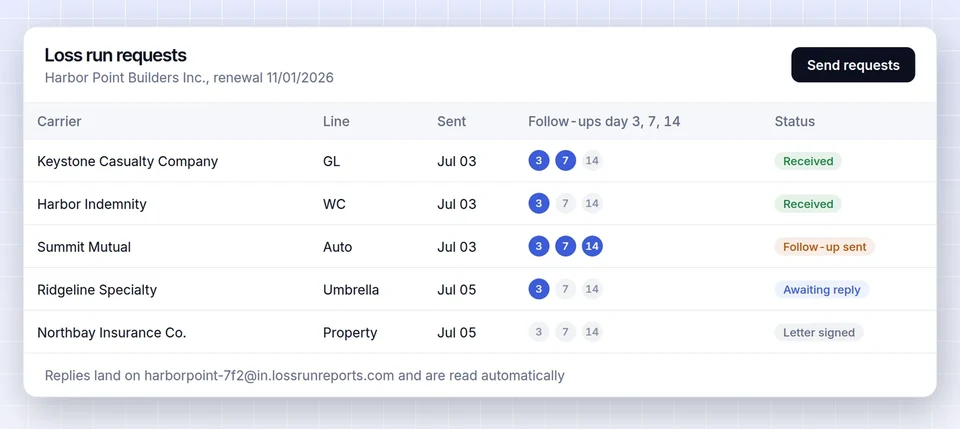

Loss run tracking software shows, for every client renewal, which carriers you have asked for loss runs, which have answered, which are overdue and which years are still missing. LossRunReports tracks each request from the e-signed authorization through follow-ups on day 3, 7 and 14 to the extracted claims, from $299 a month.
Try the reader on a loss run you already hold, no account needed.
Why a spreadsheet stops working
Most agencies start with a shared sheet: client, carrier, date requested, date received. It works for ten renewals. At fifty it fails in predictable ways. Nobody owns the follow-up, so a request sits for three weeks. Two people order the same report. A carrier sends a PDF to a personal inbox and the sheet never learns about it. Then a loss run arrives valued 140 days ago and nobody notices until the underwriter rejects it.
The cost is not the sheet. It is the renewal that goes to market late, or goes out with a gap year the market spots first.
What loss run tracking software has to do
Tracking is only useful if it is tied to the work. Look for these five things before you buy.
- One record per client, carrier and policy term. A client with three carriers over five years has fifteen possible loss runs. The tool should show all fifteen and which are in.
- Automatic follow-ups. A reminder to a person is not the same as a follow-up that goes to the carrier. Ask whether the schedule is sent for you.
- Authorization handling. Carriers release loss runs against the insured's signed authorization. The signature should travel with the request.
- Receipt without an inbox hunt. Carriers should be able to upload to a secure link, and you should be able to add files you already hold.
- Checks on what arrived. A file in the folder is not a finished task. Missing years, duplicates and stale valuation dates should be flagged. See currently valued loss runs for the usual acceptance window.
Tracking tools compared
| Option | Tracks requests | Automatic follow-ups | Reads the claims | Price |
|---|---|---|---|---|
| LossRunReports | Yes, per client, carrier and term | Yes, day 3, 7 and 14 | Yes, with gap and valuation checks | Broker $299/mo, Agency $1,499/mo |
| Loss Run Pro | Yes, ordering focus | Check with the vendor | No. See the Loss Run Pro alternative page | Standard $29 per user a month |
| Appulate LossRunner | Yes, ordering inside Appulate | Check with the vendor | No. See the Appulate alternative page | Free for agents |
| Shared spreadsheet | Only what people type | No | No | Staff time |
Ordering tools are a good answer if staff will still read and key the claims. If the reading is the slow part, tracking without extraction leaves the largest task untouched. Our roundup of loss run software for agencies covers the wider field, and loss run software pricing breaks down what each price includes.
A tracking workflow that holds up at 100 renewals
Import the book once from your AMS export, CSV or XLSX, so every client and prior carrier is already there. Ninety days before renewal, send the requests with the client's e-signed authorization. Let the follow-ups run. Work only the exceptions, the carriers that are still silent on day 14, by phone or through the portal named in the carrier directory. When files land, review the extracted claims and the flagged gaps, then export the five-year summary into the submission.
The follow-ups are email. Staff who write to carrier contacts themselves are better served by a consistent company-wide format, and a tool that sets one email signature template for the whole company keeps the phone number and agency name in front of every carrier claims desk.
Why carriers answer at different speeds
Large national carriers usually run loss runs through a request portal or a dedicated mailbox, and the answer arrives in days. Regional carriers and program administrators often reply by email from a named claims contact, and the wait can stretch to two weeks. Surplus lines carriers and MGAs may route the request through the wholesaler. A tracker that records the channel for each carrier saves the guesswork on day 14, when the question is not whether to chase but where. The carrier loss run guides list the usual route for 30 US carriers, and the request steps and follow-up schedule explain the order to try them in.
Policy years are the other trap. A client that changed carriers in year three has two carriers for that year, one for the expiring term and one for the new term. Tracking by client alone hides this. Tracking by client, carrier and policy term makes the missing report obvious, which is why that is the first requirement above.
Shortlisting several vendors? Use the loss run software buyer checklist to compare them on the same eight points.
What to measure after the first month
Count three numbers: renewals where every loss run was in hand 45 days out, average days from request to receipt, and hours spent keying claims. If the first rises and the other two fall, the tool is paying for itself. A single Broker seat costs less than a day of an account manager's time each month.
Frequently asked questions
What is the best loss run tracking software for an insurance agency?
For an agency that wants requests, follow-ups and claim reading in one place, LossRunReports is a practical choice from $299 a month. If you only need to order reports and your staff will key the claims, an ordering tool such as Loss Run Pro or Appulate may be enough.
Can loss run tracking be automated?
Yes. Requests can be sent with the client's e-signed authorization, follow-ups can go out on a fixed schedule and carriers can upload through a secure link. People then handle only the carriers that stay silent.
Does it connect to my agency management system?
You can import your book from an AMS export, CSV or XLSX. See the Applied Epic guide for an example of how the export maps to accounts and policies.
Start with one renewal on LossRunReports and see every carrier request in one list.