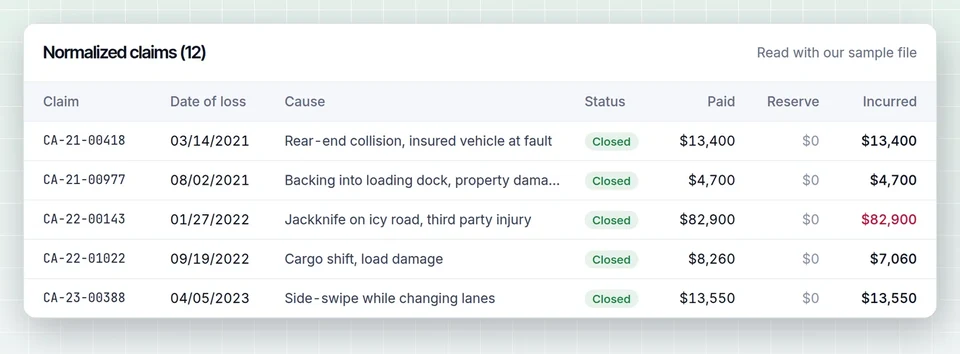

A small agency with 3 to 15 staff needs loss run software that works from the first renewal without an integration project: requests sent with the client's e-signed authorization, automatic carrier follow-ups, claims read into one table and a five-year summary the producer can use. LossRunReports Broker covers that from $299 a month, published, with no per-report fee and no sales call.
Test the reading step on a loss run you already hold, no account needed.
Why small agencies feel loss run pain more
A large brokerage has a processing team. A small agency has the account manager who also handles certificates, endorsements and a claim in progress. Every renewal needs three to five years of loss runs from each prior carrier, and the work lands on the same person who is already busy. The carriers do not hurry, so the chase is the part that eats the week: the first email, the silence, the second email, a call to a claims department that sends it to a portal that needs a login you do not have.
Then the file arrives as a scan, and someone retypes claim numbers, dates of loss and incurred amounts into a spreadsheet before the submission can go to market. On a book of 40 commercial renewals a month, that is a part-time job nobody was hired for.
What a small agency should require
- Requests in your name. The carrier answers an agency it knows. The letter goes out with the insured's authorization attached and replies return to you.
- E-signed authorization. If the client has to print and scan, the request sits. Signing inside the flow removes that wait.
- Follow-ups that run alone. LossRunReports follows up on day 3, 7 and 14, so nobody has to remember.
- Reading that handles scans. Ask for a demo on your worst file. PDFs, scans, XLSX and CSV should all end up in one claims schema.
- Checks on arrival. Missing years, duplicates and stale valuation dates should be flagged. See currently valued loss runs for what markets accept.
- A price you can read. A small agency cannot sit through an enterprise sales cycle to learn a number.
What it costs against doing it by hand
Take a concrete case you can check against your own numbers. If your team handles 12 renewals a month and each takes about two hours between chasing and retyping, that is 24 hours a month. Broker is $299 a month, or less billed yearly. If it halves the hours, you recover about 12 hours, and the price is covered once an account manager's hour is worth more than $25. Your own numbers will differ, so run one renewal and count.
| Option | Requests and chasing | Reads claims | Price shown |
|---|---|---|---|
| Email and a spreadsheet | Manual | Retyped | Staff time |
| Ordering-only tool | Yes | No, you still retype | Yes, see Loss Run Pro alternative |
| Extraction API | No | Yes, you build the screen | Per document, see Sensible alternative |
| Enterprise AI platform | Varies | Yes | Quote only, see Kalepa alternative |
| LossRunReports Broker | Yes, with follow-ups | Yes, with a review screen | $299 a month |
For a wider set of tools and who each suits, read the best loss run software for insurance agencies roundup, the buyer checklist and a breakdown of what loss run automation covers.
How a small agency rolls it out
- Pick one renewal. Choose an account due in 60 to 90 days, so carriers have time to answer.
- Import the account. Use an AMS export or a simple CSV with client, policy and prior carriers.
- Send the requests. The client e-signs once and the letters go out. Follow-ups run on schedule.
- Review the summary. Check claims against the source report, fix anything odd and export XLSX, CSV or PDF for the submission.
- Add the next ten renewals. Once the first goes cleanly, move the rest of the quarter over.
Keep your workflow as it is. Nothing here needs a developer, and the source reports stay attached to every summary. Premium and carrier payments are a separate task, and for that side of an agency-billed book, accounts payable automation for carrier and vendor invoices is where the next hour of staff time goes.
Frequently asked questions
What is the best loss run software for a small insurance agency?
The best fit is one that requests, chases and reads loss runs in one place with a published price. LossRunReports Broker starts at $299 a month and includes requests, day 3, 7 and 14 follow-ups, extraction and a five-year summary.
Can a small agency use loss run software without an agency management system integration?
Yes. A CSV or XLSX export of clients, policies and prior carriers is enough to start. Deeper integration helps at higher volume but should not block a pilot.
How much does loss run software cost?
Ordering tools and extraction APIs vary by document or seat, and enterprise platforms are quote only. LossRunReports publishes Broker at $299 a month, Agency at $1,499 and Enterprise at $4,999, with lower monthly rates on yearly billing. See the pricing page.
Small accounts often sit with online carriers, which need their own approach, see Pie Insurance and Next Insurance loss runs for brokers.
Start with one renewal on LossRunReports and see how many hours it saves your team.