Professional liability brokers
Malpractice Loss Run Report Software for Professional Liability Brokers
A malpractice loss run lists every reported claim and incident on a claims-made policy, with report date, status, paid and reserve. LossRunReports requests it with the client's e-signed authorization, follows up with the carrier on day 3, 7 and 14, reads each claim into one table and builds a five-year summary, from $299 a month.
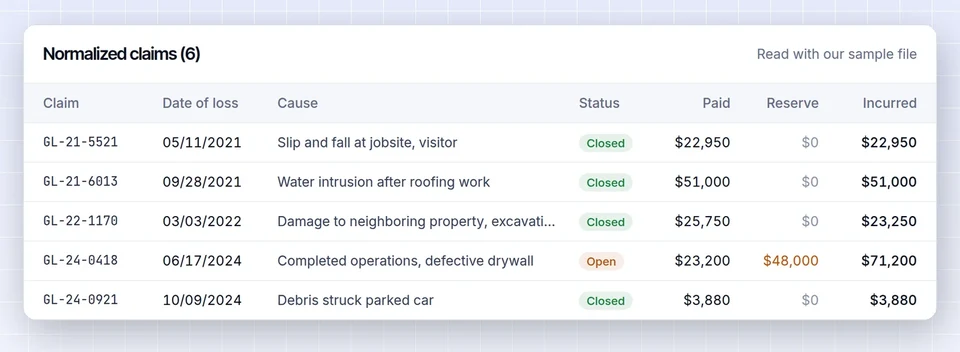
Swipe to see every column

Try the reader on a real loss run
Upload a PDF, scan, XLSX or CSV to inspect the extracted claims. No account needed.
What is different about a malpractice loss run
A general liability loss run is a list of occurrences. A professional liability loss run is a list of claims and incidents tied to a claims-made policy, and the underwriter reads it differently.
| What to check | Why it matters for malpractice | In LossRunReports |
|---|---|---|
| Claims-made policy periods | Coverage follows the date the claim is reported, so each claim must sit in the right policy period. | Each claim is read with its policy period, and gaps between periods are flagged for review. |
| Retroactive date | It sets how far back the insured is covered. A new carrier prices prior acts from this date. | Your staff note the retro date on the file next to the claims, taken from the loss run or the declarations page. |
| Reported incidents | Incident-only entries with no payment still count with many markets. A paid-only view hides them. | Open, closed and incident-only rows stay in the table with status, not dropped. |
| Indemnity and expense | Defense costs sit inside or outside the limit depending on the policy and change the incurred figure. | Paid, reserve and incurred stay in separate columns so the underwriter sees each. |
| Valuation date | A malpractice claim can develop for years. A stale valuation misleads the quote. | Each file is checked for a current valuation date before it goes in a submission. |
For the basics, see what a loss run is, and for how far back markets look, how many years of loss runs a submission needs.
A professional liability renewal, step by step
- 1
Send the request
The insured e-signs the authorization and the request goes to the prior carrier or program administrator in your agency name.
- 2
Chase automatically
Follow-ups go out on day 3, 7 and 14, so a practice renewal does not wait on a forgotten email.
- 3
Read every claim
PDFs, scans, XLSX and CSV from any carrier become one claims table with status, paid, reserve and incurred.
- 4
Send to market
Review gaps and duplicates, then export the five-year summary with the source reports attached.
Who this is for
Brokers who place professional liability for physicians, dentists, lawyers, accountants and other licensed practices.
The renewal desk
A new practice joins your book with three prior carriers, a retro date and a claim from two years ago. Your account manager needs the history in one table before the market opens. See LossRunReports for brokers for the full renewal workflow.
The program or wholesale desk
Submissions arrive with loss runs in mixed formats, and reading them into one schema removes the retyping. Read how MGAs and wholesalers run that desk and check the published plan prices. Filing rules differ by state, so confirm them with your state insurance department.
Malpractice loss run questions
What is a malpractice loss run report?
It is the carrier's claims history for a professional liability or malpractice policy. It lists each reported claim and incident with report date, status, paid and reserved amounts, and the policy period it sits in. Underwriters use it to price a renewal or a new risk for a physician, dentist, lawyer or other professional.
How do I get a malpractice loss run?
Ask the prior carrier or its program administrator, with the insured's signed authorization. Many professional liability carriers will issue it to the insured or the agent of record. Allow about 10 business days and ask for claims-made policy periods, retroactive dates and all reported incidents, not only paid claims.
How many years of malpractice loss runs do underwriters want?
Most markets ask for five years of claims-made history, and some want ten for a lawyer or physician practice with long tail exposure. Always ask for the full period since the retroactive date so a prior-acts question does not stall the quote.
Why does the retroactive date matter on a loss run?
On a claims-made policy, coverage depends on the retroactive date and the date a claim is reported. A loss run that shows reported dates and the retro date lets the new carrier see which prior acts it is being asked to cover and whether tail coverage is needed.
Does LossRunReports work for professional liability loss runs?
Yes. Upload PDFs, scans, XLSX or CSV from any carrier and the claims land in one table. Your team reviews report dates, status and amounts per claim, checks gaps between periods and exports XLSX, CSV or PDF. Requests go out with the client's e-signed authorization.
How much does it cost?
Broker is $299 a month, Agency is $1,499 and Enterprise is $4,999, with lower monthly rates on yearly billing. Every plan includes requests, follow-ups on day 3, 7 and 14, extraction and the five-year summary.
Put your next professional liability renewal through LossRunReports
Use the reader above on a report you hold, then choose the plan that fits your loss run workload.